

Misaya

Client

My Role
🧑🎨
UX Designer
Tools


Project Background
Misaya is a garment design and production firm that offers services ranging from individuals to large corporations. They specialise in manufacturing corporate uniforms and merchandising for a wide variety of industries. They pride themselves on being one of the few firms in the garment industry that can offer one-stop service due to their company comprising of sales, designers, seamstresses and factory operations teams. However, they are aiming to digitalise their workflow and faces challenges with involving their client in this new process.
My Contribution
As the UX Designer on the project, my primary goal was to research Misaya's operational and client sides to identify gaps in workflow and customer experience whilst ideating for a strategy or conceptual solution to their current obstacles. Ultimately, I delivered for the client:
-
Extensive research and data analysis on their target customers and operations.
-
Automated solution to streamline and improve workflow in servicing clients.
-
Conceptual UX/UI Design of a new web application for online garment solutions.
In-Situ Observation
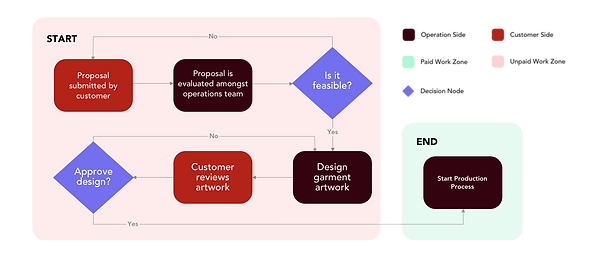
At the start of my research process, I decided to observe Misaya's sales, design, seamstress, production and delivery teams by studying their workflow, client interactions and tools to visualise a model of their current process. A deadlock that usually occurs in the journey mainly stems from unclear communication of design, materials & costs with clients that leads to repetitive, manual and menial tasks for sales and designers.
Current Workflow Model
Discovery
To gain a realistic view of my client’s workflow, I interviewed four staff members from sales and design teams to validate all of my earlier observations. Key findings from the transcripts indicated that resolving this communication issue would not only digitalise the working process and lower free-work risk but also save client's and designer's time through the automation of potential features.
My Users
I created a persona that depicts the design team, whom experience the most obstacles in the current journey. I highlighted their main tasks, goals and pain points which converges to support how their productivity and frustration is skewed by menial labour. This helps formulate the conclusion that automating simple design artwork can streamline the organisation's workflow and ultimately make talented designers more useful in other crucial areas that generate higher income for the brand.
"Tasks that involve making will be increasingly automated. Designers should spend time inventing more than making." according to ACM Interactions.

Service Journey
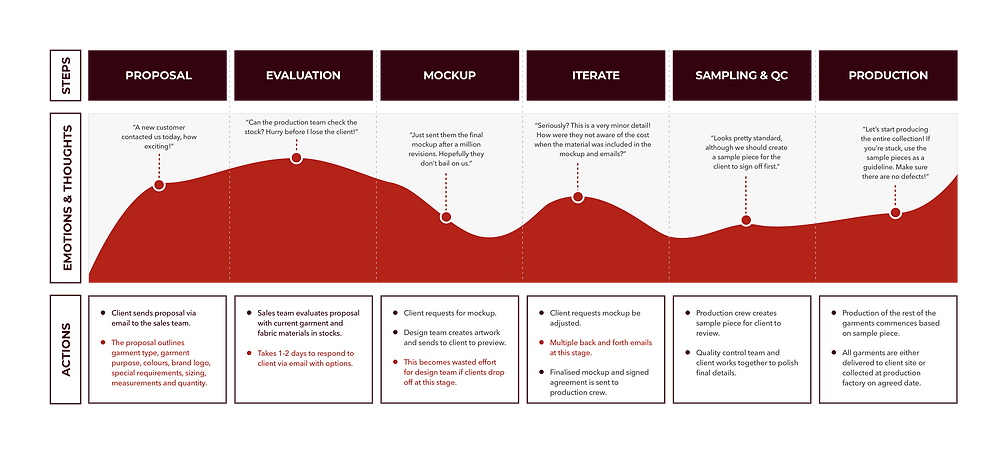
Pain Points
-
Time consuming manual tasks for garment designers.
-
Wasted effort where unapproved artwork is left unpaid.
-
Unorganised communication where staff is consumed by influx of customer emails that are difficult to keep track
Problem Statements
-
How might we reduce unnecessary workload of design staff?
-
How might we increase conversion rate of customers to go through with the production process?
Solutions
-
Design a web application to digitalise entire process into clear steps for customers.
-
Add automation features that support design for simple garments.
-
Add DIY functions for customers to upload and preview their artwork.
Concept & Design Rationale
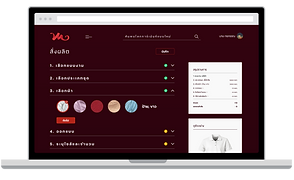
A desktop/tablet web application with an organised ordering process and DIY design features would allow customers to essentially conduct a self checkout. This would reduce the workload of sales and design team in completing repetitive and manual tasks to service customers which would allow them to focus on more productive and revenue generating tasks. With this concept in mind, I created sketches, wireframes and visual designs of the product's key screens to validate my ideas with users via Miro. I also created a clickable prototype on Figma with key screens to walkthrough the process and features with two users whom are the client's existing customers.
User Testing
The feedback from the user tests was overwhelmingly positive and customers highly prefer to automate the revision of the artwork through the platform themselves rather than waiting and depending on the designers.
Key Features



User Profiles
Account and database systems for customers to save and keep track of their garment orders.
Material Availability & Description
Retrieved and updated from inventory database to notify customers of current stock.


Save Draft for Ordering
Progress Trackers
Dynamic Pricing Update
Based on selected materials & design.
Customers can save selections to their account & return to it later.
Status indicators to help customers keep track of their progress.


DIY Garment Design
Live Artwork Preview
Customers can upload their logos, fonts & design.
Automated design feature to display customer's work instantaneously.
Expected Results
100% Growth in Productivity
From dedicating an average of 6 hours per workday, designers can now commit only 2-3 hours per workday in unpaid manual design labour and focus the remaining hours on paid work.
Higher Customer Acquisition Rate
Can scale this automated garment design platform to acquire new customers since this process is no longer capped by number of available designers.
Potential expansion to e-Commerce platform
The brand can extend the platform to setup their new venture of selling their own fashion collections via a full fledged online store.